
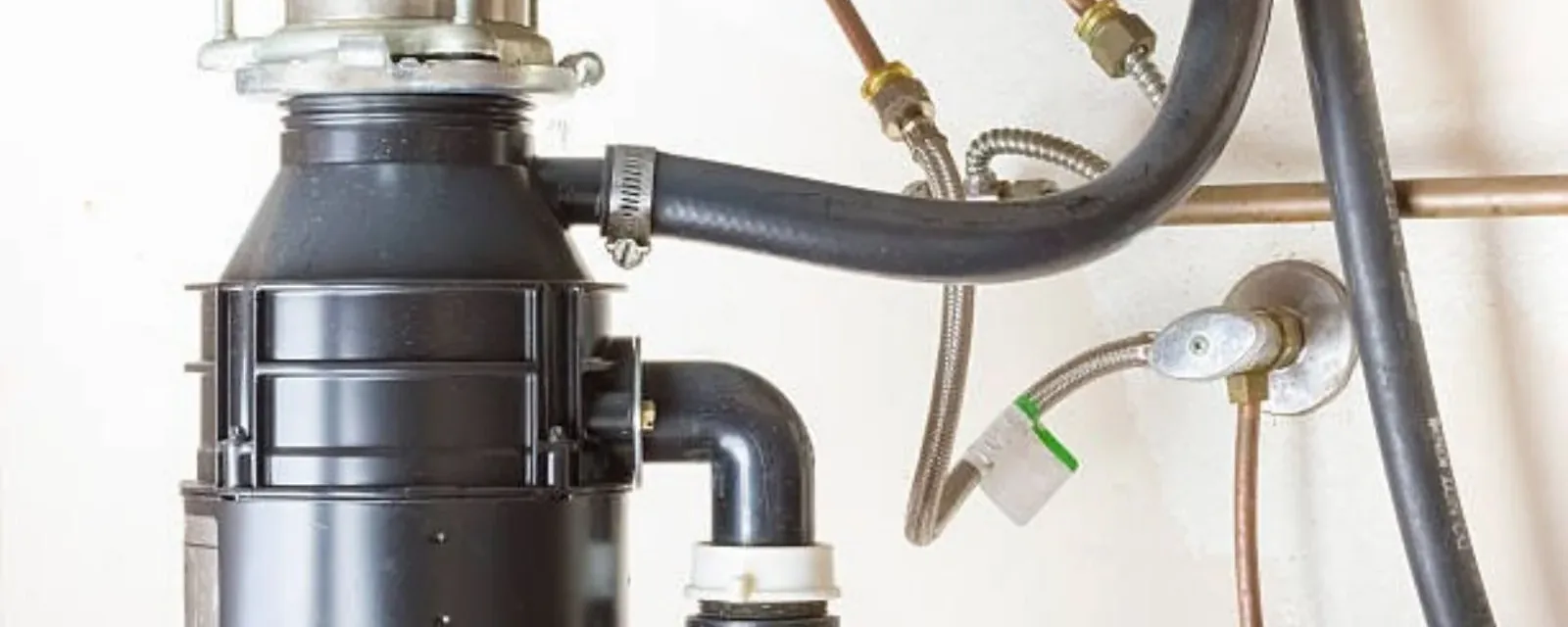
An InSinkErator garbage disposal installation has four jobs: mount the unit to the sink, supply power, connect the dishwasher (if you have one), and line up the drain. The manufacturer's instructions are the final word, and each model ships with its own sheet. This guide explains what the sequence looks like and where homeowners get stuck.
Replacing an old disposal is easier than installing the first one in a sink with no mounting hardware, a switch, or an outlet. If the kitchen has none of those, you are in electrician-plus-plumber territory, and that changes the DIY math.
The mounting sequence for a new disposal
These steps follow the manufacturer's installation guide for a first-time install. Replacement units follow a similar order but use the existing mounting parts when compatible.
- 1
Seat the sink flange
Roll plumber's putty into a rope about half an inch thick and press it around the sink opening. Set the sink flange into the putty and press down. Wipe off the squeeze-out from the top.
- 2
Build the mount from below
Slide on the fiber gasket, backup flange, and mounting flange, then the mounting ring and snap ring. Snug the three mounting screws in turns, a few turns at a time, until the assembly sits tight and even against the sink bottom.
- 3
Hang the unit
Line up the three tabs on the disposal with the ramps on the mounting ring and lift it into place. Turn the lower ring until all three tabs lock, then lock it with the wrench in the box.
- 4
Connect power
Hardwired units connect to the house wiring in the cover plate on the bottom. Corded units plug into an outlet under the sink. Turn the breaker off before touching any wire.
- 5
Connect drain and dishwasher
Attach the discharge tube, align it with the trap, then connect the dishwasher hose if you have one. Fill the sink, run water, and check every joint for leaks before turning the breaker on.
The wiring for a disposal falls under the electrical code, which the City of Hanahan lists as the 2020 National Electrical Code (NEC) with South Carolina modifications. The drain connection falls under the 2021 International Plumbing Code (IPC).
A plug-in cord kit or a hardwired connection depends on the model and the manual. When in doubt, a licensed professional should make the electrical connection.
Sources: City of Hanahan, Building Codes and SC LLR, Building Codes in Effect for South Carolina. Checked October 2026.
The dishwasher knockout plug that causes the most trouble
Many disposals ship with a small plastic plug sealing the dishwasher inlet inside the housing. If a dishwasher drains into the disposal, that plug has to come out. The manufacturer's guide says to lay the unit on its side and tap the plug out with a screwdriver and hammer, then fish the loose plug out of the grinding chamber.
Forgetting this step is the classic mistake. The dishwasher then drains into a sealed port and backs up into the dishwasher, or leaks at the hose. If the plug fell into the chamber and was never removed, it can jam the grind plate when the disposal starts.
If there is no dishwasher on that sink, leave the plug in. Removing it leaves an open port that leaks.
Electrical: hardwired or plug-in
A hardwired unit connects to the house cable through a cable connector at the access hole in the bottom plate, with the wires joined by wire nuts. The manufacturer warns against displacing the cardboard shield when pushing wires in. A corded unit uses a power cord kit that plugs into an outlet under the sink.
Kitchen wiring carries rules we will not guess at. If you need a new outlet, a switch on the wall, or a new circuit, hire a licensed electrician. If wet hands, a cut wire, or an old and brittle cable is involved, stop and call someone.
Ready to book?Call and we will find the earliest slot, often the same day when the schedule allows.
Call (855) 575-2890DIY or hire: how to decide
A quick sort based on what your sink already has:
| Your situation | DIY realistic? | What to watch |
|---|---|---|
| Swapping an existing disposal for a similar model | Usually yes | Reuse the mounting parts if the manufacturer says they fit. Check the drain trap alignment. |
| First disposal, outlet and switch already under the sink | Yes, with care | Dishwasher plug, putty seal, and leak testing. |
| First disposal, no outlet or switch | Hire out the electrical | New electrical work should be done by a licensed electrician. |
| Old or corroded drain piping, slow drains | Call a plumber | A disposal will worsen a drain that already struggles. |
| Double bowl sink needing a new trap layout | Plumber likely | Trap geometry decides whether it drains cleanly. |
| Disposal leaks from the bottom of the unit | Replace the unit | Internal seal failure is not a repair. |
Drain connection and getting the alignment right
The disposal's discharge tube has to line up with the drain trap. Rotate the unit until it does. If the tube is too long, cut it. If it is too short, buy an extension. A kitchen drain that is slightly off can be fixed with a longer tube, but a stubbornly misaligned trap needs a new trap arm.
A dishwasher hose often runs through an air gap or a high loop before reaching the disposal. Some homes use a high loop instead of an air gap.
After assembly, test with the sink full and the water running. The manufacturer says to check the sink flange, dishwasher connection, tailpipe, and mounting assembly for leaks before turning the breaker back on.
Tools and parts to gather first
A short pre-job list prevents mid-job trips to the hardware store:
- Plumber's putty, wire nuts, and a cable connector (the cable connector is not always included)
- Hammer, flathead and Phillips screwdrivers, channel-lock pliers, and a pipe wrench
- A power cord kit if your hardwired model needs a plug and your sink has an outlet
- A discharge tube extension and a dishwasher drain connector kit if your layout needs them
- A bucket, rags, and a flashlight for the dark cabinet
- The model's own installation sheet, since the exact steps vary slightly by model
What a plumber checks that a first-timer often misses
A plumber looks at the trap and the downstream pipe before the disposal goes in. A disposal moves food particles into a drain that may already have a grease coating or a partial clog. Putting a new motor on an old restricted drain gives fast failures and a stink.
They also check the sink itself. A thin or cracked sink flange area, a loose sink, or a poor putty bed leaks from above. And they look at the cabinet for old water damage, because a slow leak from the previous unit can have rotted the floor of the cabinet.
Cost depends on whether a new circuit or switch is needed, how much of the drain must change, whether a dishwasher connection is being added, and the unit's size and model. We give a clear price before work starts.
When this becomes an emergency
A leak under the sink that is running steadily, or a unit that is humming and hot or smoking, needs fast action. Turn the disposal's switch off, flip its breaker, close the sink's supply stops, and keep the cabinet dry. Our plumbers handle after-hours cases through burst pipe repair and garbage disposal repair, and we serve Ladson and Summerville as well.
After installation: run it right
Run cold water before, during, and for about 15 seconds after grinding. Feed small amounts of soft food waste at a time. Keep grease, coffee grounds in bulk, fibrous stalks, bones, and pits out of it. Grease especially coats the line downstream and builds up into clogs.
If the unit hums and does not spin, shut off power first and never put a hand into the chamber.
Hanahan local note: permits, licensing, and who to ask
Whether a disposal swap needs a permit depends on the work involved, and we will not state a rule from memory. The City of Hanahan Building and Codes department handles permit questions, and the City lists its office at (843) 576-5259 with weekday office hours. Ask them before you start if electrical work or a new circuit is part of the job.
If you hire out any part, verify the contractor. The SC Residential Builders Commission, part of the Department of Labor, Licensing and Regulation, licenses residential plumbing contractors. LLR licenses the individual, and a Certificate of Authorization is the company license. Check the plumber, not just the truck.
Hanahan homes from the 1970s growth are now roughly 45 to 55 years old, so an under-sink drain may be older than the disposal you are installing. A plumber can look at the trap and arm before a new unit goes in.
- Sources checked (manufacturer installation guide (InSinkErator), City of Hanahan Building and Codes page, state licensing board (SC LLR))
- InSinkErator: Installing a New Garbage Disposal
- City of Hanahan Building and Codes
- SC LLR Residential Builders Commission
Frequently asked questions
Do I have to remove the dishwasher knockout plug?
Only if a dishwasher drains into that sink. The manufacturer's guide has you tap the plug out from the inside with a screwdriver and hammer and then remove the loose piece. If there is no dishwasher, leave it in.
Can I install a disposal without a switch or outlet under the sink?
You can mount it, but you cannot power it safely without wiring. New outlets, switches, or circuits are electrician work. Ask the City of Hanahan Building and Codes department about permit questions first.
How long does a disposal installation take?
A swap with matching connections is the quickest case. A first-time install with new wiring, a dishwasher hookup, or trap changes takes longer. Plan time for leak testing and cleanup too.
Why does water come back up in my sink after the new disposal is in?
Usually the drain downstream is partly blocked or the trap is misaligned. The disposal is pushing waste into a line that cannot take it. A cable machine or a camera look will show where the restriction is.
Is a disposal a good idea for a Hanahan home on an older drain line?
It depends on the line. An older cast iron or heavily scaled kitchen drain may already be narrowed inside, and a disposal adds solids. Ask a plumber to look at the drain first.