
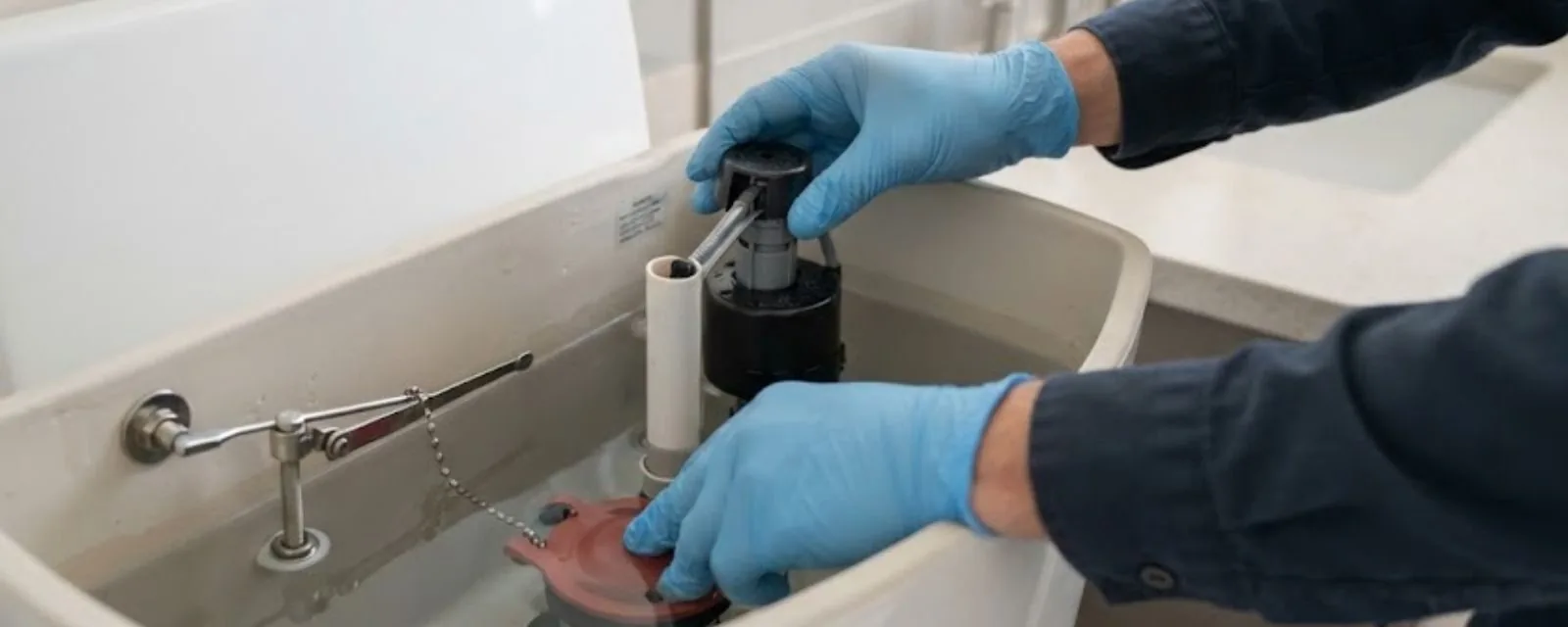
Toilet repair covers everything from a worn flapper to a failed wax ring and a full replacement of the fixture. An overflowing bowl or a puddle spreading from the base is urgent, because water reaches the subfloor and the drywall below faster than most people expect.
Before you do anything else, find the small oval or round valve on the wall or floor behind the toilet, just under the tank. Turn the handle clockwise until it stops. That one move cuts off new water to the tank, and it is the most useful thing you can do while you wait for a plumber.
Water around the toilet: where it is really coming from
Not every puddle is the same problem. Water that shows up only after a flush points to the seal at the base. Water that is there all day, even when nobody has used the bathroom, usually comes from the supply line, the shutoff valve or the tank bolts. Beads on the outside of the tank on a humid day are condensation, not a leak.
A quick test saves time. Dry the floor, the tank, the supply line and the valve with a towel, then tuck a strip of dry toilet paper beside each connection. The paper that goes damp first tells you which joint is wet. Tell the dispatcher what you found, because it shapes which parts we bring.
Setting or replacing a toilet changes the drain connection, so the plumbing code applies. The City of Hanahan lists the 2021 International Plumbing Code (IPC), with South Carolina modifications, as the code its Building and Codes department works from.
Replacing a flange or moving a toilet is different work from changing a flapper, so describe the job to the City if you are unsure whether a permit applies.
Sources: City of Hanahan, Building Codes and SC LLR, Building Codes in Effect for South Carolina. Checked October 2026.
Overflowing toilet: what to do while you wait
Stop the water first, protect the floor second. Do these in order.
Close the valve behind the toilet
Turn the oval handle clockwise until it stops. If it is stuck or weeping around the stem, do not force it, since old stems snap. Go to the main shutoff instead.
Lift the tank lid
If the bowl is still rising, press the rubber flapper down into its seat or lift the float arm. That stops tank water from pouring into the bowl.
Do not flush again
A second flush on a blocked line sends more water over the rim. Use a flange plunger if you have one, and stop there.
Keep power and people clear
Lay towels around the base and keep cords off the wet floor. Switch off a breaker only if you can reach the panel while standing on dry ground, otherwise stay out and call 911 or the electric utility.
Close the main if water keeps coming
If the valve fails or the pipe itself is leaking, turn the main shutoff where the line enters the house clockwise until it stops.
Symptom, likely part and who should fix it
Use this to sort a small DIY job from a call.
| What you see | Most likely cause | DIY or call |
|---|---|---|
| Tank refills every few minutes with no one using it | Worn flapper or a pitted flush valve seat | A flapper swap is a fair DIY. Call if the seat is rough or the tank is cracked. |
| Hissing or a trickle that never stops | Fill valve not shutting off, or a float set too high | Adjust the float first. Replace the fill valve if it will not seal. |
| Water at the base after each flush | Failed wax ring or loose closet bolts | Call. The toilet has to be lifted and reset. |
| Toilet rocks when you sit | Loose bolts, damaged flange or uneven floor | Call. A rocking toilet breaks its seal again. |
| Damp supply line or valve | Worn compression nut, cracked line or a leaking valve stem | A braided line is a reasonable DIY. Call if the valve itself drips. |
| Bowl rises, tub gurgles, other drains are slow | A clog past the toilet trap | Call for a drain problem, not a toilet repair. |
A cracked bowl or tank cannot be repaired reliably. It needs replacement.
Water or sewage problem right now?Call the 24/7 line. A licensed plumber, a clear price before work starts.
Call (855) 575-2890Leak at the base: wax ring and closet flange
The wax ring sits between the underside of the toilet and the closet flange, the ring bolted to the floor over the drain. It seals the toilet outlet to the waste line. When the wax is crushed, shifted or hardened, water and sewer gas slip past it, and the water ends up on the floor or soaks into the subfloor.
Rings fail for a few reasons. A toilet that rocks works the seal loose, a flange sitting too low after new flooring goes in leaves a gap, and old age does the rest. If the flange is cracked or rusted, a new wax ring alone will not hold. The flange may need a repair ring, and on older cast iron lines the drain stub may need attention too.
Before resetting a toilet, a plumber presses on the floor around it. A spongy feel, dark staining or a musty smell means the leak has run for a while. Mention that on the call. Replacing rotted subfloor is carpentry work and may need a separate trade, so we will tell you what we find and what the repair involves.
A bead of caulk around the base looks tidy but cannot stop a failed seal. It can also trap a slow leak where you will not see it. Fix the seal, then caulk if you like.
The tank parts that wear out first
Most running and weeping toilets trace back to one of these.
Flapper
The rubber seal over the flush valve. It stiffens and warps with age, then leaks tank water into the bowl.
Fill valve
Refills the tank after a flush. When it sticks you hear hissing, or the water climbs into the overflow tube.
Flush valve seat
The drain opening at the bottom of the tank. A pitted seat will not seal even a brand new flapper.
Supply line
The braided or rigid line from the shutoff valve to the tank. Replace a kinked, stiff or damp one before it fails.
Tank bolts and washers
Rubber washers at the tank bolts drip onto the bowl. Snug them gently, since porcelain cracks under force.
A toilet that runs, hisses or flushes by itself
A running toilet or a faint leak into the bowl wastes water without making a mess, so it is easy to ignore until the bill arrives. Put a few drops of food coloring in the tank and wait 15 minutes without flushing. Color in the bowl means the flapper or seat is leaking. A tank that keeps rising to the top of the overflow tube means the fill valve is at fault.
If the toilet is quiet but your meter keeps moving, the water may be going somewhere else. Leak detection checks the rest of the house so you are not replacing parts that were never the problem.
How a replacement or new installation visit runs
This is the usual sequence when a repair no longer makes sense.
- 1
Confirm the rough-in
We measure from the wall to the center of the flange so the new bowl fits. Many toilets are 12 inches, but older bathrooms vary.
- 2
Shut off and drain
Close the supply valve, flush, and sponge the last water out of the tank and bowl.
- 3
Pull the old toilet and inspect
We check the flange, the floor and the drain opening, and plug the opening with a rag while we work.
- 4
Set the new toilet
A new wax ring or gasket goes in and the bolts are tightened evenly until the bowl sits level and still.
- 5
Connect, test and clean up
A new supply line goes on, then several flushes while we watch the base for seepage. The old toilet leaves with us.
When a clogged toilet is really a drain problem
A plunger should clear an ordinary toilet clog in a few strokes. If the bowl rises, the bathtub gurgles or a nearby floor drain bubbles when you flush, the blockage is past the toilet in the branch or main line. More plunging then just pushes waste around. That calls for drain cleaning, and a camera look if it keeps returning.
Only toilet paper and waste belong in the bowl. Wipes sold as flushable, paper towels and feminine products catch on rough spots in older lines. If the clog repeats, tell us how often and which fixtures are affected. Roots or a collapsed section are a different job, and sewer line cleaning is the next conversation.
Before the plumber arrives
A few minutes of preparation protects your floor and your claim.
- Photograph the water, the toilet and any wet ceiling in the room below.
- Write down when it started and what you did to stop it.
- Move rugs, mats and cabinet contents away from the wet area.
- Find the brand and model, often stamped inside the tank or under the lid.
- Keep any parts you removed so the plumber can match them.
- Look at the ceiling below for sagging or brown stains and stay clear of it.
If water reached walls or flooring, tell your insurance carrier before any major cleanup.
What affects the price of a toilet repair or replacement
We do not quote prices on a web page. These are the things that move the number.
- Repair or replace
- A flapper or fill valve is a small repair. A cracked bowl or a worn older toilet that clogs all the time often makes more sense to replace.
- Hidden damage
- A soft subfloor, a damaged flange or a corroded drain stub adds scope. We tell you what we find before we continue.
- The fixture
- Pressure-assisted, one-piece and taller bowls cost more than a basic two-piece. The fixture price is separate from labor.
- Access and timing
- Tight bathrooms, upstairs rooms and after-hours calls change the time and the rate.
- Valves and lines
- Old shutoffs and stiff supply lines are usually replaced while the water is off, since they are the next thing to fail.
Insurance often covers sudden overflow damage but not wear and tear on the toilet itself, and a leak that ran for months is often treated differently. Ask your carrier before you throw anything away.
Call, describe what you see, and we will explain a clear price before work starts.
Frequently asked questions
Do you handle toilet repair emergencies at night or on weekends in Hanahan?
Yes. Our dispatch line runs 24/7, and an overflowing or leaking toilet is a call we take after hours. Same-day appointments are offered when available for repairs that can wait until morning.
Close the valve behind the toilet, then call and describe the water.
Can I keep using a toilet that leaks at the base?
It is best to stop. Each flush pushes water and sewer gas past a failed seal, and the moisture can soften the subfloor. Close the supply valve and use another bathroom until the toilet is reset.
How do I know whether to repair or replace?
Parts like a flapper, fill valve and supply line are cheap to swap, so repair wins when the bowl and tank are sound. Replacement makes sense for cracks, repeated clogging, a rocking base that keeps breaking its seal, or a toilet where several parts are failing at once.
Is the water around a toilet safe to touch?
Tank and supply water is clean. Anything that came up through the bowl or a drain should be treated as contaminated, so wear gloves, ventilate the room and wash your hands. Carpet or porous material that soaked up bowl water often cannot be saved.
What if the clog is in the sewer line outside?
The City of Hanahan lists Berkeley County Sanitation for sewer issues and Charleston Water System for water, so confirm which utility serves your street. A blockage on the public side is theirs, and a blockage on your side is yours. We can tell you which side we think it is.
Do you serve homes outside Hanahan?
Yes. We serve Hanahan and nearby towns, including Goose Creek, and we ask for your street when you call so we can confirm coverage.
How do I check that a plumber is licensed?
South Carolina licenses residential plumbing contractors through the Residential Builders Commission, part of the Department of Labor, Licensing and Regulation. The license belongs to the individual, with a Certificate of Authorization for the company. Verify any plumber with LLR before work starts.