
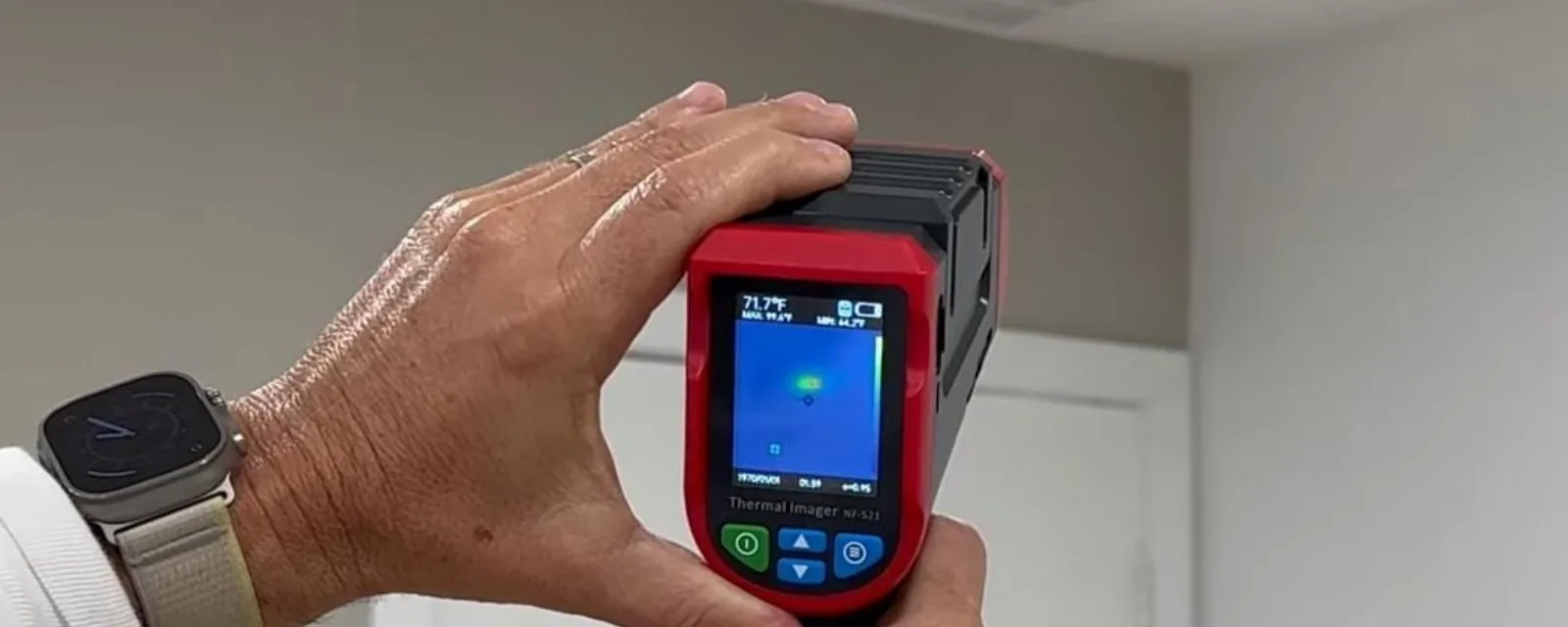
Leak detection means finding exactly where pressurized water is escaping from a pipe, without opening every wall and floor to guess. It starts with a symptom you can check yourself: the meter creeping with every tap closed, a floor that feels warm underfoot, a ceiling stain that spreads after each shower. If that is happening now, our 24/7 dispatch can send a licensed plumber, and the steps below limit the damage while you wait.
In October 2015 the National Weather Service reported 15 to 20 inches of rain across the Charleston tri-county area, with some spots over 25 inches. That storm is a reminder that a soggy yard is not proof of a plumbing leak, and a dry yard is not proof you have none. Wet soil and a failing pipe look alike from the porch, so ask one question: does the meter move when nobody is using water?
Suspected leak right now: what to do while you wait
Water you cannot see can still ruin drywall and flooring fast. Do these in order.
Close the main shutoff
Turn the main shutoff at your house clockwise until it stops. If you cannot find or close it, call Charleston Water System at (843) 727-6800. If the meter dial stops, the leak is somewhere past that valve.
Keep water and electricity apart
If water drips near a fixture, outlet or panel, switch off that breaker only if you can reach the panel while standing on dry ground, otherwise stay out and call 911 or the electric utility.
Contain what you can see
Set a bucket under a ceiling drip and move furniture. Do not poke a bulging ceiling when wiring or a light is anywhere near it.
Photograph before you wipe
Take photos of the stain, the meter dial and any wet material for your carrier.
Call the 24/7 line
Tell dispatch what the meter is doing, where the stain is and whether you closed the main. Same-day appointments are offered when available, and after-hours calls go to the 24/7 line.
Signs of a hidden leak, from the quietest to the loudest
Most hidden leaks announce themselves early. A bill that climbs without a change in household size is the most common sign. Others are a faint hiss from a wall at night, pressure that sags, a hot tap that takes longer than it used to, and a musty smell in a closet or hallway.
Some signs point to places. A floor tile that stays warm can mean a hot line beneath it. A stain below a bathroom suggests a fitting upstairs. A lush, soggy strip of lawn between meter and house can mean a buried line is weeping. None of these proves a leak alone, since condensation and a clogged air conditioner drain copy them, so we start with the meter and a pressure check before anything gets cut open.
Water meter still running or a high water bill
If the meter moves while every fixture is off, water is going somewhere. That is the cleanest evidence of a leak you can gather without tools. Many meters also have a small leak indicator that turns when even a trickle passes. If yours turns with everything off, treat it as a leak.
A high bill is trickier because it is a monthly total. A running toilet flapper, a stuck irrigation valve and a broken underground line all add up to the same jump. Run the home test below first.
If the meter holds still and the bill still looks wrong, call CWS at (843) 727-6800 about the bill itself. They can check the account, the meter and your read history. If the meter moves, you have a leak and we can find it.
Water or sewage problem right now?Call the 24/7 line. A licensed plumber, a clear price before work starts.
Call (855) 575-2890A home meter test that is safe to do yourself
You need a flashlight, a pen and about an hour.
- 1
Stop every use of water
No flushing or taps. Pause the dishwasher and washer, turn off the ice maker if you can and set the irrigation timer to off.
- 2
Read the meter
Lift the box lid with a stick or screwdriver, not your fingers, since insects and spiders like those boxes. Write down the register numbers and note whether the leak indicator is turning.
- 3
Wait without using water
Give it at least 30 minutes. An hour is better for a slow leak.
- 4
Compare the reading
Any change in the numbers, or an indicator that kept turning, means water moved while the house was idle.
- 5
Check the toilets
Add a few drops of food coloring to each tank, wait 15 minutes without flushing and look in the bowl. Color there means that flapper leaks.
- 6
Split the house from the yard
Close the main shutoff at the house and watch the meter again. If it still moves, the leak is on the buried line. If it stops, the leak is inside.
How leaks are found: methods and what each one can see
No single tool finds every leak. A careful technician combines methods so one result confirms another.
| Method | Best at finding | Honest limits |
|---|---|---|
| Acoustic listening | The hiss of a pressurized leak in supply pipe, on walls, floors and in the yard | Plastic pipe carries sound poorly, and traffic or appliances can mask a small leak |
| Thermal imaging | Temperature patterns from a hot line or wet material behind drywall or under flooring | It shows temperature, not water, so results need confirming |
| Moisture meter | How far moisture has spread in drywall, wood and subfloor | It cannot tell a supply leak from roof water or condensation |
| Pressure testing | Whether an isolated section of supply line holds pressure | It proves a leak exists in that section but not the exact spot |
| Tracer gas | Small leaks in lines buried or under a slab where sound is weak | The line must be emptied and filled, and readings depend on soil and cover |
| Drain camera | Cracks and breaks inside drain and sewer pipe | Drain lines only, not pressurized supply |
A meter test and a pressure test say a leak exists. Listening and thermal work narrow it down. A moisture reading and a small opening confirm it before anything is cut.
Ceiling or wall leak: a stain, bubbling paint or a drip
A ceiling stain shows where water arrives, not where it starts. Water follows framing and wiring holes, so the source can sit several feet away. Timing is the best clue. A ring that grows when nobody uses water points to a supply line, and a stain after showers suggests a drain or loose fitting.
A stain only after rain points to the roof. One that appears when the air conditioner runs often means a clogged condensate drain.
We read the drywall with a moisture meter, check the surrounding area and pressure test the supply lines serving that area. If a supply pipe has split, the work becomes pipe repair, and we can usually say how big an opening is needed before cutting starts.
Under-house and crawlspace leaks
Homes on raised foundations hide most plumbing in the crawlspace, where a small drip can run for months. Signs are damp or sagging insulation, a musty smell through floor vents, a soft floor near a bathroom and a wet vapor barrier under a fixture.
A technician checks supply lines, drains and the water heater area with a light and a moisture meter, and a specialist method when needed, named before booking. We stay out of a crawlspace with standing water near wiring. A poured slab floor is a different process, covered on our slab leak page.
Underground and buried line leaks
The pipe between meter and house runs under lawn, driveway or plantings, so a leak there may never show. Warning signs are a meter that moves even with the house main closed, pressure that drops over time, grass that stays green or soggy in a dry week, or the faint sound of running water outside.
Listening gear and a pressure test can place the leak within a short stretch of pipe. For a hard to reach line, a specialist method may help, and we name it before booking. Repair choices are on our water line repair page. Where the utility's responsibility ends and yours begins depends on the meter location, so confirm with CWS before anyone digs.
Commercial leak detection
The same methods work in a small shop, office or restaurant. Larger buildings with several meters, fire sprinklers or roof drains are different work. Tell dispatch the building type when you call so we can say honestly whether we fit, and see commercial plumbing for what we handle.
Sprinkler and irrigation leaks
Irrigation hides high bills because the water ends up on the lawn. A stuck zone valve, broken head or cracked lateral can run every night. Run the meter test with the controller off, then again with a single zone on. If the meter moves only when a zone runs, or a valve box is full of water, the problem is in that zone.
Pool and spa leaks
Pool leaks split into the shell and liner, which belong to a pool company, and the fill and return plumbing, which we can pressure test and locate. A falling water level alone does not prove a leak, since evaporation and splash-out take water every week, so run a bucket test first.
Leaks at the meter box and in the yard
A meter box that stays full of water or a wet spot right at the meter deserves a call to CWS at (843) 727-6800 first, because the fitting at the meter may be theirs. Water in the box can also be rain or groundwater, so note whether it returns after a dry spell. We do not work on the utility's equipment.
What to have ready before the leak technician arrives
A few minutes of preparation helps us test the right parts of the house.
- The meter reading and time from your home test, and whether the indicator was turning
- Where the main shutoff is, and whether you closed it
- Your foundation type: slab, crawlspace or a mix
- Clear access to the crawlspace door, water heater and under-sink cabinets
- Photos of every damp spot, taken before you wipe or paint
What affects the price of leak detection
A clear price should come before work starts, and these factors explain why two jobs differ.
- Where the leak is likely to be
- A faucet supply line is quick to check. A line under a slab or a long buried run needs more equipment and time.
- How many methods it takes
- A meter test and pressure test may confirm a leak. Locating one in a concealed line can need listening and other specialist methods, which we name before booking.
- Access to the pipes
- Open crawlspaces are easier than finished walls, tile and landscaping.
- Hour and day of the call
- After-hours dispatch costs more to staff than a scheduled weekday visit.
- Repair after the find
- Locating a leak and fixing it are separate tasks, and repair cost depends on pipe material, depth and wall or floor repair.
Many homeowner policies cover sudden, accidental water damage, and some cover the cost of reaching the pipe. They often exclude a leak that went on for months. Ask your carrier before work starts and keep photos and your meter log.
Describe what your meter and your house are doing, and we can give you a clear price before any work starts.
Frequently asked questions
Do you handle leak detection emergencies at night or on weekends in Hanahan?
Yes. Our dispatch runs 24/7, and a licensed plumber can be sent after hours when a leak is actively damaging the house. We serve Hanahan and nearby towns such as Goose Creek and North Charleston.
While you wait, close the main shutoff and photograph the damage.
How do I tell whether the leak is mine or the water utility's?
Close the main valve at the house and watch the meter. If it still moves, the leak is between the meter and the house or at the meter itself. Call CWS at (843) 727-6800 to confirm who owns that stretch before digging.
Will you cut into my wall or floor just to look?
Not as a first step. We test with the meter, pressure and listening tools, then confirm with moisture and thermal readings. Any opening should be as small as the repair allows, and you hear the plan and price first.
My bill doubled but the meter test shows nothing. What now?
Repeat the test at a different hour with the irrigation off. If the meter still holds, the bill may come from higher usage or an estimated read, and CWS is the place to ask. A leak that only runs when a zone cycles can hide in a short test.
Does homeowners insurance pay for leak detection?
It depends on your policy. Coverage often applies to sudden, accidental damage and sometimes to locating the source, while long-term seepage is commonly excluded. Ask before work starts.