
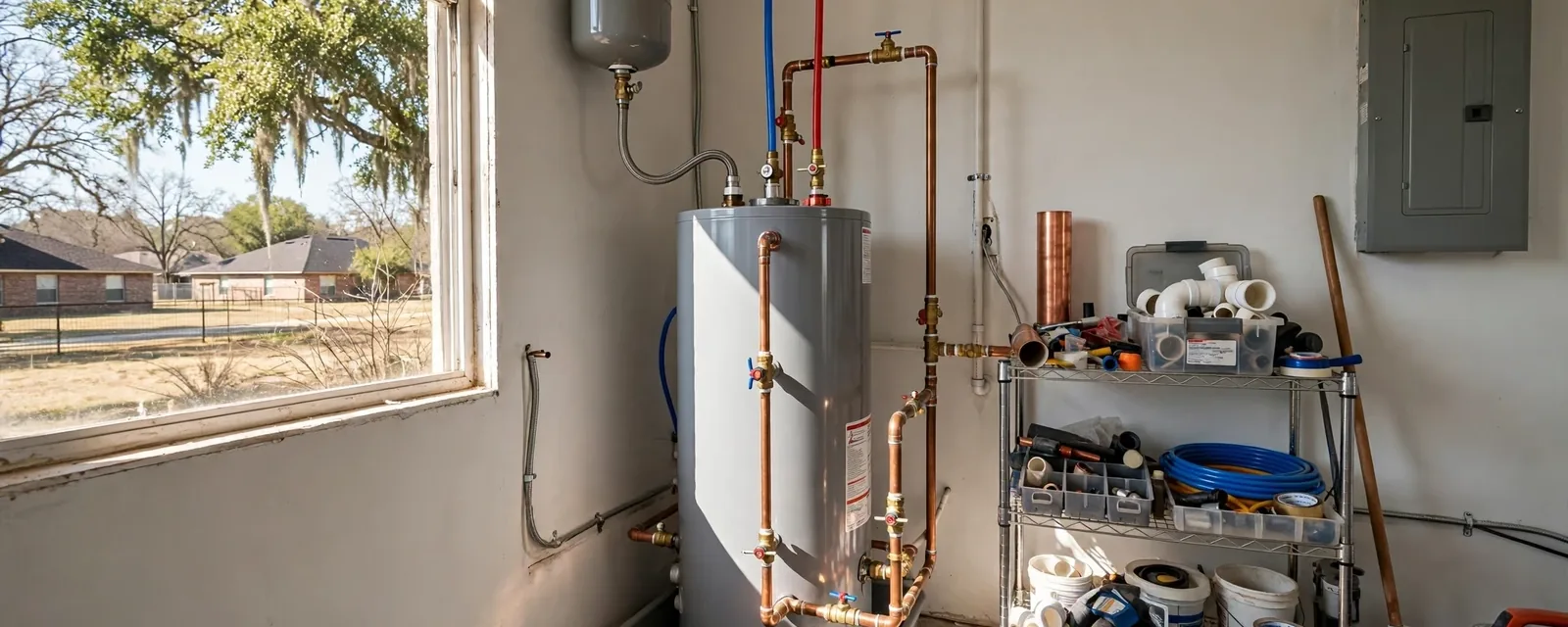
Water heater installation is the full job of setting a new heater in place, connecting water, gas or power, venting combustion gases, and adding the safety parts that keep it from becoming a hazard. A tank bought online is only the start. The plumbing around it is what makes it safe and last.
We schedule planned installs on a normal appointment, and we offer same-day appointments when available. If your current tank is already leaking, our water heater replacement service is built for that.
Who handles what when the heater is gas
The City of Hanahan Public Works page lists Dominion Energy for electric and natural gas. In plain terms, the utility handles service up to its meter. The pipe, shutoff valve, sediment trap and appliance connector inside your house are normally the plumber's work. Confirm with Dominion Energy where its side ends if your meter or regulator looks old.
That split matters on installation day. If we find a corroded gas connector, a missing shutoff, or a gas smell, we stop and call the utility. Anyone who tells you to ignore a gas smell is not someone to hire. Leave the building, call 911 and Dominion Energy from outside, and wait.
The City of Hanahan lists the 2021 South Carolina Plumbing Code, or the 2021 International Plumbing Code (IPC) with South Carolina modifications, and the 2020 National Electrical Code (NEC) with South Carolina modifications. A water heater install touches both: the relief valve and drain are plumbing items, and an electric unit's circuit falls under the NEC.
Whether your job needs a permit is a question for the City of Hanahan Building and Codes department. Ask before the old tank comes out.
Sources: City of Hanahan, Building Codes and SC LLR, Building Codes in Effect for South Carolina. Checked October 2026.
Gas or electric: which fits your house
A short decision table. Your existing hookups decide most of it.
| Question | Gas tank | Electric tank |
|---|---|---|
| What does it need to run? | Gas line, vent to outside, combustion air | A dedicated circuit and breaker of the right size |
| Where can it go? | Anywhere with a safe vent path | Almost anywhere with power and space |
| Recovery speed | Generally faster | Generally slower |
| Operating cost | Depends on local gas and power rates | Depends on local gas and power rates |
| Switching to the other fuel | Needs panel and circuit work | Needs a gas line and a vent |
| Main safety issue | Venting, backdrafting, carbon monoxide | Wiring, heating elements, high-limit |
Heat pump water heaters are electric, need roughly 1,000 cubic feet of air space around them according to DOE, and are a separate conversation.
Before installation day: what to confirm
These keep the visit short and the price accurate.
- Fuel type, tank size and brand of the current heater, plus a photo of the data plate.
- Where the heater sits: garage, closet, attic, crawlspace, utility room.
- Floor drain or a place for the relief valve discharge line to run safely outside or to a drain.
- Clear path and workspace. Move storage boxes away from the heater.
- Whether the current vent is single-wall pipe, B-vent, or PVC.
- Any existing expansion tank, water pressure reading or recirculation line.
- A question for the City of Hanahan Building and Codes department about whether this job needs a permit.
Ready to book?Call and we will find the earliest slot, often the same day when the schedule allows.
Call (855) 575-2890Expansion tanks, relief valves and drain lines
When cold water heats inside a closed tank it expands. If the supply has a check valve, a pressure-reducing valve or a backflow device, that extra volume has nowhere to go, pressure climbs, and the relief valve eventually weeps. A small thermal expansion tank on the cold supply gives the water somewhere to go. We check static pressure before we decide.
The temperature and pressure relief valve is the safety valve of last resort. It must be sized for the tank, discharge through a pipe that ends where scalding water cannot hit anyone, and never be capped or plugged. The drain valve at the base lets the tank be flushed, and a drain pan with a line to a safe place limits damage if the tank fails years later.
These parts are a small share of the job and a large share of the risk. A heater installed without them can work for years, and then fail with no warning.
Venting: where gas installs go wrong
A gas water heater makes exhaust gases that include carbon monoxide. The vent must lift them out of the house on a continuous upward path, through a pipe sized for the heater, with the right slope, supports and clearance to combustibles. An older atmospheric vent relies on hot gas rising by itself. If the new heater has a different input, or the vent has been shortened or rerouted, the draft can fail.
Power-vent and condensing heaters use a fan and plastic pipe, which allows runs through a side wall. They need an electrical outlet and a condensate path. Pick the heater with the vent route in mind, not after.
We recommend a carbon monoxide alarm near every gas appliance and bedroom, whatever heater you choose.
How we install a water heater
A planned install follows this order.
- 1
Site check
Measure the space, confirm fuel, vent path, water pressure and electrical or gas capacity.
- 2
Set up and shut off
Isolate water and energy, drain the old tank or prepare the new location.
- 3
Set and plumb
Level the heater, add a drain pan, connect with new flexible connectors and shutoff valves, and add an expansion tank when needed.
- 4
Connect fuel and vent
Gas line with sediment trap, leak-tested. Or electrical connection at the right amperage. Vent assembled and sealed.
- 5
Fill, purge and test
Open the hot tap to purge air, check every joint, set the temperature, fire the burner or energize the elements, and confirm draft.
- 6
Walk-through
We show you the shutoffs, the relief valve, the thermostat and how to read the data plate.
What affects the price of installing a water heater
Two installs of the same tank can differ a lot. These are the reasons.
- Heater type and size
- A standard 40-gallon electric is a different product than a 50-gallon power-vent gas unit or a hybrid.
- Venting work
- New vent runs, liners, transitions and condensate drains add materials and labor.
- Code parts
- Expansion tank, pan, discharge line, shutoffs and connectors depend on the plumbing code and the site.
- Location and access
- Attic and crawlspace installs, stairs and long runs take more time.
- Permit and inspection
- Ask the City of Hanahan Building and Codes department. If a permit applies, it is added time and cost.
Installing a new heater is normally a maintenance expense, not an insured loss. Insurance may help if a covered event, such as a sudden failure, caused the replacement. Keep your receipts and ask your carrier.
Call, tell us what you have now and what you want, and we will give a clear price before work starts.
Questions to ask any installer
These apply to us and to anyone else.
Is the plumber licensed?
SC LLR's Residential Builders Commission licenses the individual, and a Certificate of Authorization is the company license. Ask LLR to verify it.
Will the price include the code parts?
Expansion tank, drain pan, discharge pipe, connectors and shutoffs should be named in writing.
Who handles the permit question?
Ask the City of Hanahan Building and Codes department, and tell the installer what they said.
What happens to the old tank?
Haul-away should be in the quote, not a surprise.
Related work that often comes up
If you are upgrading to on-demand heat, read about our tankless water heater work first, since gas sizing and venting change. For a heater that is failing right now, water heater repair may buy time. Bigger remodels fall under plumbing installation.
We install across Hanahan and nearby towns, including Ladson and Goose Creek. Our blog has a do-it-yourself overview if you are curious how the install works, but gas and venting are not a casual weekend job.
Frequently asked questions
Do I need a permit to install a water heater?
Ask the City of Hanahan Building and Codes department. Rules depend on the work, and we do not state them for you. We can tell them what we plan to install.
Should I choose gas or electric?
Usually whatever your house is already set up for. Switching fuel adds a gas line and vent, or an electric circuit and panel capacity.
Why does a water heater need an expansion tank?
Heated water takes up more room. If your supply has a check valve or a pressure regulator, the extra volume has nowhere to go. An expansion tank absorbs it and keeps the relief valve quiet.
What is the pipe that comes off the side of my heater?
That is the relief valve discharge line. It must stay open and run downward to a safe place. Never cap it.
How long does a new heater last?
Tank heaters typically last about 8 to 12 years. Care, water conditions and anode rod condition change that.
Can you install a heater I bought elsewhere?
Often yes. Tell us the model, and we will check that it fits the space and vent. We prefer to confirm before you buy.
Who do I call about the gas meter?
Dominion Energy, from outside the house, if you smell gas. For a regulator or meter question, call Dominion first. For piping in the house, call us.