
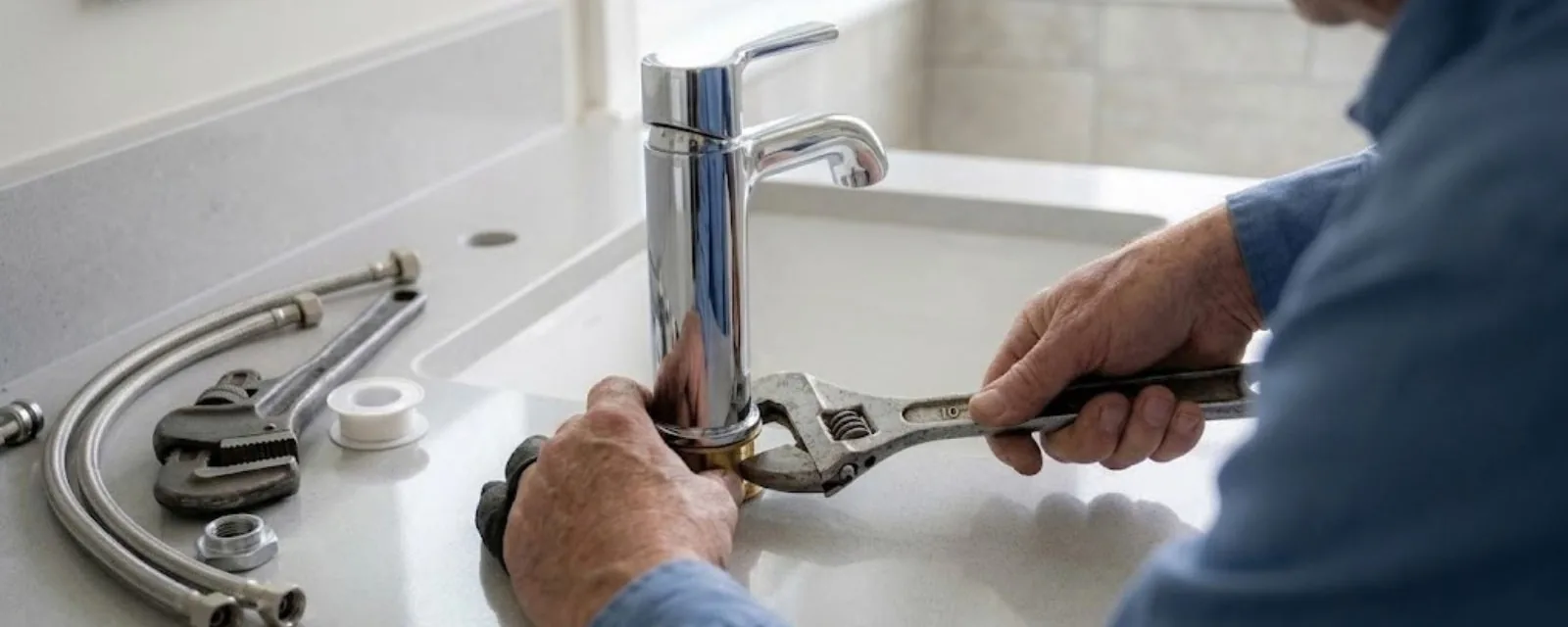
The EPA says a faucet that drips once per second can waste more than 3,000 gallons a year. Leaking faucet repair in Hanahan, SC homes mostly comes down to replacing a small rubber or metal part that has worn out: a washer, an O-ring, a seat, a cartridge or a set of ceramic discs.
The part depends on the faucet's design. Below we cover the four common designs, how to tell them apart, the sequence for a typical repair, and the point where you should call a plumber instead of buying another repair kit.
Four faucet designs and four different leaks
Compression faucets have separate hot and cold handles that you turn several times to open or close. Inside each is a rubber washer pressed against a metal seat, and the washer wears out. Cartridge faucets use a plastic or brass cartridge that slides or rotates, and they leak when its seals fail.
Ball faucets have a single lever over a rounded cap, and they use a metal or plastic ball with rubber seats and springs. Ceramic disc faucets, usually a single handle on a wide cylinder, use two polished discs that seal against each other. All four also use O-rings that can leak at the spout base or under the handle.
Homeowners in Ladson and Summerville can ask which design they have, and the table that follows answers it.
Faucet type, how to spot it, and the part that usually fails
Find your faucet in the first column and read across.
| Faucet type | How to spot it | Where it usually leaks | Usual repair |
|---|---|---|---|
| Compression | Two handles that turn multiple times | Drips from the spout, even when closed | New washer, and often a new seat |
| Cartridge | One or two handles that move smoothly, with a retaining nut or clip | Drips from the spout, or leaks at the handle base | New cartridge or new O-rings |
| Ball | Single lever over a rounded cap | Leaks at the base of the handle or the spout | Replacement kit with seats, springs and O-rings |
| Ceramic disc | Single handle on a wide cylinder | Drips from the spout or leaks below the handle | New cylinder or seals |
If you cannot tell the type, look for the brand name on the handle or under the sink, and search for the model number before you buy parts.
How to repair a dripping faucet
These steps fit most faucets, with small differences by design.
- 1
Shut off the water
Close the two supply stops under the sink by turning them clockwise, then open the faucet to relieve pressure.
- 2
Protect the sink
Plug the drain and lay a towel over it so a dropped screw does not vanish.
- 3
Remove the handle
Pry off the cap, remove the screw, and lift the handle off. Some have a small set screw on the side.
- 4
Pull the internal parts
Unscrew the retaining nut or clip, then pull the stem, cartridge, ball or cylinder straight out.
- 5
Replace worn parts
Swap the washer, seat, O-rings, springs or the whole cartridge, using exact matches.
- 6
Reassemble and test
Reverse the steps, open the stops slowly, and check for drips at the spout and base.
Ready to book?Call and we will find the earliest slot, often the same day when the schedule allows.
Call (855) 575-2890Seats, springs and O-rings: the small parts that cause big drips
On a compression faucet, a new washer pressed against a pitted seat still drips. Run a fingertip around the seat. If it feels rough, a seat wrench can remove it for replacement, or a seat dresser can smooth it. Skipping this step is why many washer replacements fail within a month.
O-rings are the likeliest cause when a faucet leaks from the base of the spout or under the handle rather than from the tip. Coat new O-rings with silicone plumber's grease before you slide them on, and match the size exactly. A wrong-sized ring seals for a day and then weeps.
Supply stops and supply lines: leaks under the sink
Water under the sink is not always the faucet. Check the two supply lines and the shutoff valves, called stops. A drip at the nut can often be fixed by snugging the nut, but a corroded braided line or a leaking stop needs replacing.
If a stop will not close, or it weeps at its stem, the fix is to replace the valve, which first means shutting off water at the house main. That is a good time to call a plumber for faucet and sink repair, because a stuck valve can break when forced.
Match the replacement part before you shop
Matching parts is where most DIY faucet repairs go wrong.
- Take a clear photo of the faucet and its handle before you take it apart
- Note the brand and any model number on the faucet body or under the sink
- Bring the old washer, O-ring, cartridge or seat to the store and match it side by side
- Count the splines or notches on a stem, because look-alikes differ
- Buy the manufacturer's kit when one exists, instead of a universal part
- Replace both hot and cold parts on a two handle faucet at the same time
Repair or replace the faucet
A repair kit costs little compared with a new faucet, and fixing a drip is usually the right move. Replace the faucet when its finish is flaking, when the body is corroded or cracked, or when the maker no longer sells parts for it.
A new faucet does not fix a worn shutoff valve or a failing supply line, so replace those at the same time. If the old faucet is one you have repaired twice already, replacement usually saves a third trip to the store.
When a faucet leak becomes an emergency
A drip can wait. A supply line that has burst, a faucet body that has cracked and sprays, or water running down into a ceiling is different. Close the stop under the sink by turning it clockwise. If it does not close, shut off the main valve at the meter or at the house.
Then call (855) 575-2890 for emergency burst pipe repair. A leak that stops once you close the stop is a daytime repair, and the 24/7 line is for the one that does not.
Hanahan local note: moderately soft water means worn parts are the usual cause
Charleston Water System calls its water moderately soft, at an average of 58.4 ppm or 3.4 grains per gallon. Its 2024 monthly results ranged from 45 to 77 mg/L of total hardness. That means crusty mineral buildup on cartridges and aerators is milder here than in hard water cities, so a drip in Hanahan is more often a worn washer, a pitted seat or a tired O-ring than a scale problem.
Start with the seals and seat, not a vinegar soak. If an aerator does clog, unscrew it and rinse out debris. If your water itself looks rusty, CWS says to run a cold faucet until it clears and to call (843) 727-6800 if it persists, because that is a water system question and not a faucet part.
Hanahan grew quickly in the 1970s, from 8,376 residents in 1970 to 13,224 in 1980, so many homes are now roughly 45 to 55 years old. In houses that age the original under-sink stops may be stiff or weeping, so plan to replace them whenever you replace the faucet.
- Sources checked (utility FAQ (Charleston Water System), utility water quality report (CWS 2024 monthly averages), federal agency guidance (U.S. EPA WaterSense), state encyclopedia (population history))
- Charleston Water System FAQ (hardness, 3.4 grains per gallon)
- Charleston Water System, Water Quality Reports
- U.S. EPA WaterSense, Fix a Leak Week
- South Carolina Encyclopedia, Hanahan
Frequently asked questions
Why is my faucet dripping from the spout?
The seal inside has worn. On a compression faucet that is a washer and often the seat. On a cartridge, ball or ceramic disc faucet, it is the cartridge, the seats and springs, or the disc seals.
Can I fix a leaking faucet without shutting off the main?
Yes, if the stops under the sink close fully. Turn them clockwise and open the faucet to confirm the flow stops. If a stop will not close, shut off the water at the main before you proceed.
How do I know whether my faucet is a cartridge or a ball type?
A ball faucet has one lever over a rounded cap and uses springs and seats inside. A cartridge faucet usually has a retaining nut or clip and a cylindrical cartridge. Look for the brand name and the model number.
Is a leaking faucet worth repairing?
Yes. The EPA says a faucet that drips once per second can waste more than 3,000 gallons a year, and the repair is usually a low cost part. The bill, not the noise, is the reason to fix it.
Does Hanahan's water cause my faucet to leak?
Not usually. CWS water is moderately soft, at 3.4 grains per gallon, so scale is milder than in hard water areas. Worn rubber, pitted seats and old O-rings are the common causes of a drip.