
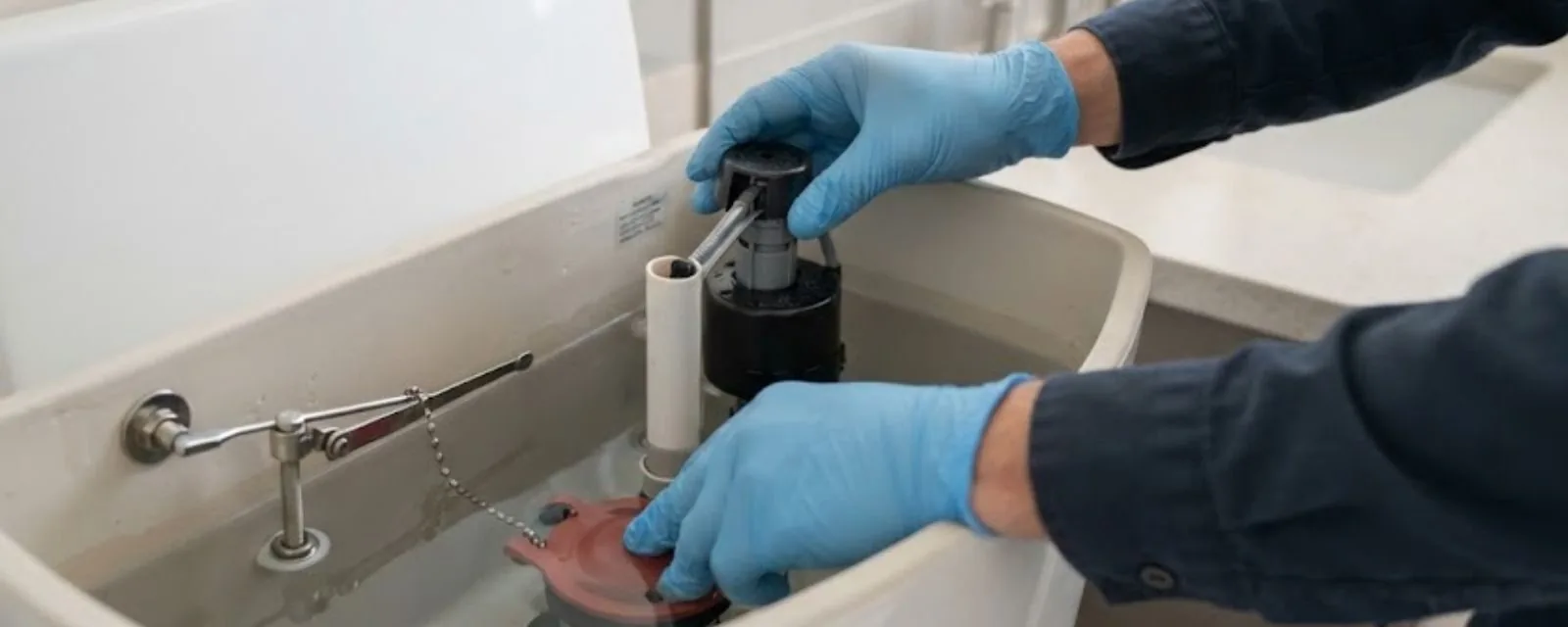
To repair a leaking toilet tank, first figure out whether the water is leaking out of the tank onto the floor, or leaking through the tank into the bowl. Floor water points to the tank-to-bowl bolts and gasket, the supply connection, or a cracked tank. A tank that refills on its own points to the flapper or the fill valve.
Most of these repairs use a screwdriver, an adjustable wrench and a part that costs little at a hardware store. The cracked tank is the exception, and we will explain how to recognize it. Take your time with the diagnosis, because replacing the wrong part is the usual reason a toilet keeps leaking.
Find out where the water is coming from
Do this before you buy parts.
- 1
Dry everything
Wipe the tank, the bolts, the supply line, the shutoff valve and the floor until they are dry.
- 2
Wrap tissue at the suspects
Hold dry toilet paper against the bolts, the supply fitting and the base of the tank. Wet paper tells you the exact spot.
- 3
Check for sweating
A cold tank in warm humid air collects condensation all over its surface, which looks like a leak but is not one.
- 4
Run the dye test
Add a few drops of food coloring to the tank water, wait about 10 minutes without flushing, and watch the bowl.
- 5
Look for a hairline crack
With the tank dry, look along the seams, the bolt holes and the bottom edge for a line that weeps water.
Where you see water and what usually causes it
Use this table to match a symptom to a part.
| Where you see water | Likely cause | Typical fix |
|---|---|---|
| Dripping from the underside of the tank where it meets the bowl | Worn tank-to-bowl gasket or loose bolts | Replace the gasket and bolts with washers |
| Wet around the shutoff valve or supply nut | Loose or worn supply connection | Snug the nut, replace the washer or the braided line |
| Colored water appears in the bowl after the dye test | Flapper not sealing | Replace the whole flapper |
| Tank refills every few minutes without a flush | Flapper leak or a fill valve slightly out of adjustment | New flapper, then adjust or replace the fill valve |
| Water running into the overflow tube | Water level set too high or fill valve not shutting off | Lower the float, or replace the fill valve |
| Wetness along a seam or at a bolt hole with no loose parts | Cracked tank | Replace the tank, not a patch |
| Water beads over the entire outside of the tank | Condensation | Insulate or tolerate in humid weather, not a leak |
If the tank is dry and the floor is wet, check the wax ring at the base of the toilet. That is a bowl leak, not a tank leak.
The dye test, step by step
The EPA's WaterSense program describes the test this way: place a drop of food coloring in the tank, and if color shows up in the bowl after about 10 minutes without flushing, you have a leak. It also says to flush right away afterward so the dye does not stain the tank. Use enough dye to be visible, and do not flush during the wait.
A clean bowl after 10 minutes means the flapper is sealing. Check the other suspects, such as the bolts and the supply line, because the leak is somewhere else. Colored water in the bowl points to the flapper, and the EPA says the cause is often an old, faulty flapper and that replacing the whole rubber flapper is usually best.
Ready to book?Call and we will find the earliest slot, often the same day when the schedule allows.
Call (855) 575-2890Replacing tank-to-bowl bolts and the gasket
This is the repair for water that leaks from the tank onto the floor.
- 1
Shut off and empty the tank
Close the shutoff valve by turning it clockwise, flush, and sponge out the last water so the tank is light and dry.
- 2
Disconnect the supply line
Loosen the nut at the bottom of the tank, with a small bucket under the fitting.
- 3
Remove the old bolts
Hold the bolt head inside the tank with a screwdriver while you loosen the nuts underneath, then lift the tank straight up.
- 4
Replace the gasket and bolts
Set a new spud gasket on the bowl, drop in new brass or stainless bolts with rubber washers, and seat the tank evenly.
- 5
Tighten gently and alternate
Snug each nut a little at a time. Porcelain cracks if you crank on one side, so stop when the tank no longer rocks.
- 6
Reconnect and test
Reattach the supply, open the valve, let the tank fill, and flush a few times while checking for drips with fresh tissue.
Flapper and fill valve: the parts that leak inside the tank
A flapper that has hardened, warped or collected grime on its seat lets water seep into the bowl, and the fill valve then refills the tank without anyone flushing. The fix is a new flapper that matches the size of your flush valve opening, usually 2 or 3 inches. Take the old one to the store to match it.
If the tank keeps refilling after a new flapper, check the water level. It should sit about an inch below the top of the overflow tube. A fill valve that does not close fully, or a float set too high, sends water down the tube and into the bowl all day. Adjust the float or replace the fill valve.
Fill valves are inexpensive and swap out in a few minutes, and a toilet repair visit usually includes both parts when the toilet is old.
When a cracked tank means replacement
A crack in the porcelain tank cannot be reliably fixed. Epoxy or sealants may slow a weep for a while, but the tank is under constant water weight and can fail without warning. If you see a crack with water seeping from it, plan to replace the tank or the whole toilet.
Tanks are heavy, and pairing a new tank with an old bowl can mismatch the bolt pattern and flush valve. Many homeowners replace the whole toilet to avoid that problem. A plumbing installation visit can set a new toilet and check the supply stop at the same time.
When a toilet leak becomes an emergency
Treat the leak as an emergency if the tank is cracked and water is running onto the floor, a supply line has burst, or the water is reaching ceilings below or electrical outlets. Close the shutoff valve at the wall by turning it clockwise. If that does not stop the flow, close the main valve at your meter or at the house.
Then call (855) 575-2890 for emergency toilet repair. Homeowners in North Charleston and Goose Creek can call the same 24/7 line for toilet leaks.
Hanahan local note: catching a silent toilet leak with the meter or dye
Charleston Water System says a running toilet can silently waste up to 200 gallons a day. Its High Bills and Leaks page recommends putting a few drops of food coloring in the tank and checking whether color reaches the bowl. If it does, replace the flapper first. A leak that never makes a sound can run for weeks, so run the dye test before you assume the bill is a mistake.
For the meter check, turn off every fixture and look at the meter. CWS says that if it registers water movement, water is being used somewhere and you likely have a leak. CWS also says new meters show a faucet icon when flow patterns suggest a leak, and older meters have a red triangle that turns when water passes through. The EPA's version is to read the meter, wait two hours with no water use, and read again.
CWS says an unusually high bill is typically caused by a change in water use or a leak. Its leak adjustment applies to sewer charges for qualifying leaks where the water did not enter the sewer system, and the page says toilet leaks do not qualify. That makes early repair worth more. For bill questions call CWS at (843) 727-6800, and confirm who serves your street if you are unsure.
- Sources checked (utility customer page (Charleston Water System, High Bills and Leaks), utility customer page (Charleston Water System, About Your Water Meter), federal agency guidance (U.S. EPA WaterSense), city government page (City of Hanahan Public Works))
- Charleston Water System, High Bills and Leaks
- Charleston Water System, About Your Water Meter
- U.S. EPA WaterSense, Fix a Leak
- U.S. EPA WaterSense, Fix a Leak Week
Frequently asked questions
Why is my toilet tank leaking at the bottom?
Water at the underside of the tank where it meets the bowl is most often a worn gasket or loose tank-to-bowl bolts. Dry everything, wrap tissue around the suspects, and flush. Wet tissue shows the exact spot.
Can I fix a cracked toilet tank with epoxy?
An epoxy patch may slow a seep, but it is not a dependable repair. The tank holds several gallons and can split further, so plan on replacing the tank or the toilet.
How do I do a dye test on a toilet?
Add a few drops of food coloring to the tank, do not flush, and wait about 10 minutes. Color in the bowl means water is leaking past the flapper. Flush right afterward so the dye does not stain the tank.
How much water can a leaking toilet waste?
Charleston Water System says a running toilet can silently waste up to 200 gallons a day. The leak is often invisible, because the water slides down the bowl without a sound.
Will Charleston Water System adjust my bill for a toilet leak?
CWS's High Bills and Leaks page says toilet leaks do not qualify for its leak adjustment on sewer charges. Policies can change, so call CWS at (843) 727-6800 to confirm what applies to your account.