
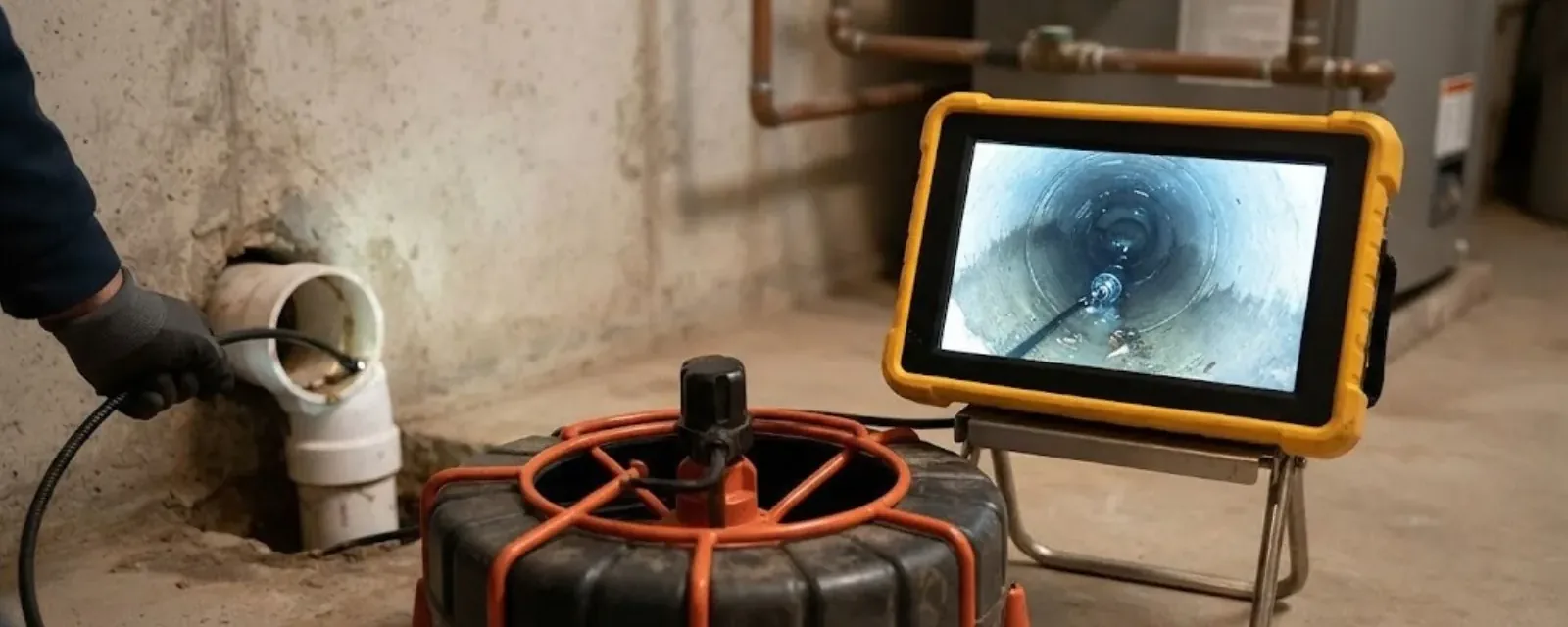
Many Hanahan homes date from the 1970s growth and are now 45 to 55 years old, so a scope shows a line you cannot see on a walkthrough. A sewer scope inspection sends a small waterproof camera down the main drain line from a cleanout and records what it sees. You get video and a report that shows the pipe material, cracks, roots, sags and breaks, along with the distance to each problem.
So, should you get one? If you are buying a home built decades ago, yes. If you own a home with slow drains, repeat backups or a yard that stays wet, also yes. If your home is new and the drains run fine, it matters less. The rest of this post explains what the camera can find, who benefits, and what to do with the results.
What a camera finds in a drain line
The camera shows what a cleaning cannot. Roots entering at joints appear as fuzzy white or brown masses. Cracks show as dark lines along the pipe wall. A sag, called a belly, shows as a pool of water sitting in the pipe with the camera partly submerged.
Offsets appear where one pipe section has shifted and no longer lines up with the next, leaving a lip that catches paper and waste. Cast iron lines show rough, flaking scale and sometimes a pipe that looks narrowed by buildup. A collapsed section appears as a pipe that is crushed, filled with soil or simply absent.
The plumber should also note the pipe material at different points, because older homes sometimes have a mix, such as cast iron inside the house joined to clay or plastic outside.
Buyer or owner: who gets what from a scope
The same footage helps two different readers.
| Situation | What the scope tells you | What to do with it |
|---|---|---|
| Buying an older home | Condition of a pipe you cannot see | Use findings in your inspection response and offer |
| Selling a home | What a buyer's scope might find | Fix known issues or disclose and price accordingly |
| Owner with repeat backups | Whether roots, a belly or a break is the cause | Decide between cleaning, lining or replacement |
| Owner planning a remodel | Pipe condition before new work is built over it | Repair first, then finish |
| Owner of a newer home | Baseline record of a healthy line | Keep the video for comparison later |
What the report should show
A useful report is specific. Ask for these items.
- Recorded video of the whole run, not a few clips
- The point where the camera entered and the total distance covered
- Pipe material and any changes in material along the run
- The distance from the entry point to each defect, and a photo of each
- A plain description of cracks, roots, bellies, offsets, breaks and scale
- A note if the camera could not pass a blockage or collapse, and where that was
- A recommendation separating urgent items from monitor-only items
If a report says only 'pipe looks fine' with no video or distances, ask for more detail.
Ready to book?Call and we will find the earliest slot, often the same day when the schedule allows.
Call (855) 575-2890Roots, bellies, offsets and cast iron: what each means for you
Roots mean there is an opening, even a small one. Cutting them gives temporary relief, and repair or lining of the joint stops the cycle. A line with root entry at a single joint is a very different problem from roots throughout.
A belly means standing water in the pipe. It may work for years with regular cleaning, or it may cause repeat backups. Fixing it requires replacing that section to restore slope, and a lining will not change it. Our sewer line repair team looks at bellies this way.
An offset or a cast iron line with heavy scale are judgment calls. A small offset may be monitored. A badly scaled cast iron line, especially one that is narrowing, may need cleaning and then repair. Hydro jetting can clear scale and grease so the next camera pass sees the true pipe wall.
Using the results in an offer or negotiation
Buyers: book inside your contract's inspection period. For a buyer, the scope is evidence. If the video shows a break or a heavy belly, you can ask the seller to repair it, to give a credit, or to lower the price. Get a written repair scope from a plumber so you are negotiating from a defined figure and not a guess.
A clean scope also has value. It tells you that the section of pipe is in decent shape, and you can plan your budget around other items. Keep the video, since it becomes a baseline for the future.
Do not rely on a verbal summary at the closing table. Ask for the file, the report and the plumber's written opinion on whether a defect is urgent. If you are unsure how to interpret what you see, our sewer inspection service can walk through the recording with you.
Questions to ask before the scope
Ask where the camera will enter. A cleanout outside is ideal. If none exists, the plumber may need to pull a toilet or access the line another way, and you should know that going in.
Ask whether the line will be cleaned first, whether the camera records continuously, and whether the report will include a locate of any defect on the surface. A locate lets you know where in the yard the problem sits, which matters for repair planning.
Ask what happens if the camera hits a blockage. A good plumber stops, tells you, and discusses clearing the line, not just writing 'could not complete' and leaving.
When this becomes an emergency
A scope is planned work, but a sewer backup is not. If wastewater is rising in a tub, shower or floor drain, stop using water and call right away. Our sewer line cleaning service handles the clearing, and the camera can run once the line is open.
Homeowners in Goose Creek and Ladson can call us after a backup too. The first job is to restore flow, and the second is to find out why it stopped.
Hanahan local note: confirm who owns the sewer lateral
The City of Hanahan Public Works page lists Berkeley County Sanitation (843-572-4400) for sewer issues and Charleston Water System for water. That tells you who to ask, but it does not tell you where your responsibility ends on a given street.
The ownership boundary of a sewer lateral depends on the utility. In some places the owner is responsible all the way to the main in the street, and in others the utility takes over at a property line or cleanout. Do not assume. Call the utility that serves your street and ask them where their responsibility ends.
Why does it matter? If a scope finds a defect, the answer to who pays and who repairs depends on which side of that line it sits. Get the answer before you spend money, and write down the name of the person you spoke with.
- Sources checked (City of Hanahan Public Works page)
- City of Hanahan, Public Works, Important Phone Numbers
Frequently asked questions
How long does a sewer scope take?
It depends on access and line length, and a clean, reachable cleanout makes it faster. Ask the plumber for a time estimate when you book.
Does a scope damage the pipe?
Rarely. Damage comes from forcing the camera past a blockage or through weak old pipe, which is why a competent plumber stops and tells you.
Is a scope part of a standard home inspection?
Usually not. A general home inspection looks at visible plumbing, and a sewer scope is a separate service. Ask your inspector.
Who should read the video?
A plumber who can explain it to you. Watching it with them, you can see the defect and the pipe around it, which makes the repair conversation easier.
Who is responsible for my sewer lateral in Hanahan?
It depends on the utility that serves your street and where its responsibility ends. The City page lists Berkeley County Sanitation for sewer issues, so call them and ask before planning any repair.