
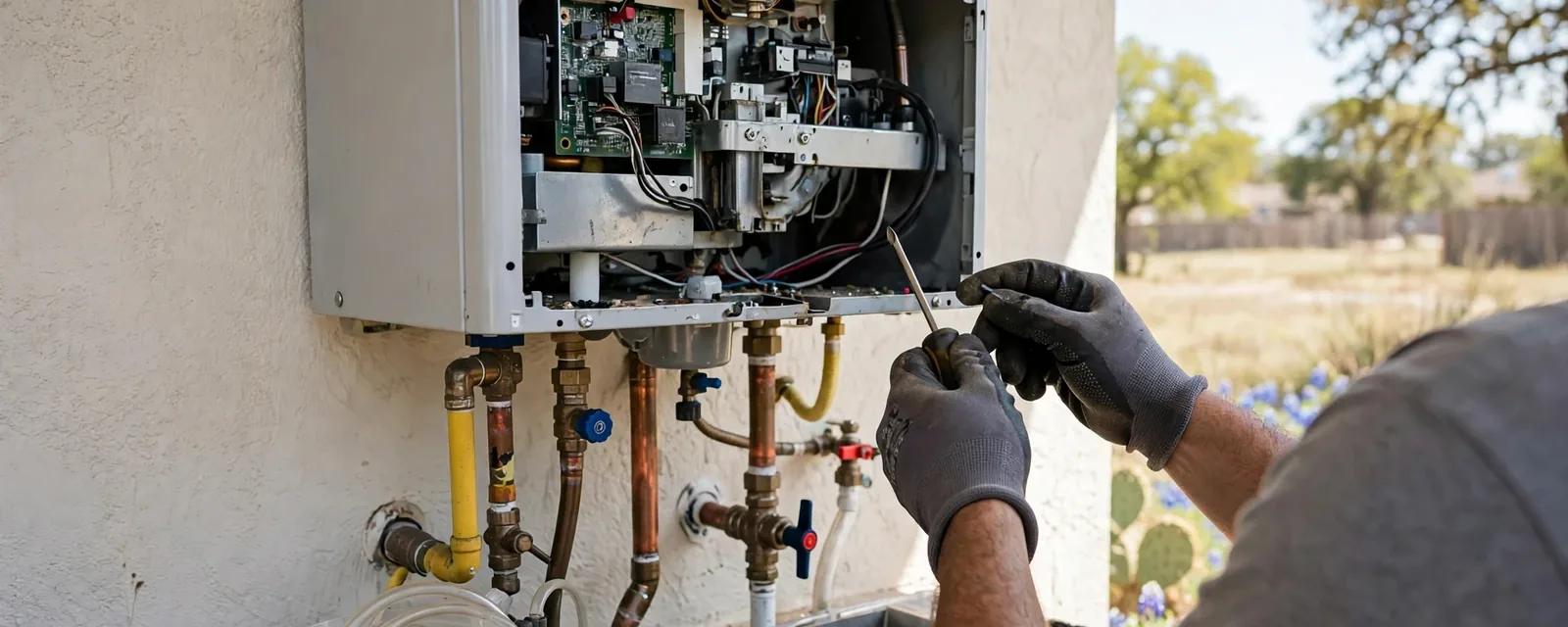
The tankless hot water heater cost for a Hanahan, SC home has two parts: the unit, and everything the house must change so the unit can run. Gas models often need a bigger gas line and a different vent. Electric models can need a heavy circuit that your panel may not have to spare. That second part is where quotes for the same brand swing apart.
We do not put prices on a web page. We do give you a clear price before work starts, and this guide helps you judge it. It covers the Department of Energy's efficiency numbers, a tank versus tankless table, and the questions to ask before you sign anything.
What you are really paying for with a tankless unit
The heater is one line. The others are the gas line sized for a higher burst of fuel, a vent made for the unit's exhaust, a condensate drain on high efficiency models, a circuit or breaker for the controls, new water connections, and isolation valves with ports for flushing. A good quote shows each as its own line so you can see where the money goes.
Replacing a tank with a tankless unit also changes the plumbing layout. The tank sat on the floor with its connections at the top, and the tankless unit hangs on a wall. Pipes get moved, and sometimes the new location is across the room. Our tankless water heater service page covers the install side, and water heater replacement covers the tank side of the choice.
Tank versus tankless: a side by side table
The Department of Energy figures below compare tankless units to conventional storage tank heaters.
| Question | Storage tank | Tankless |
|---|---|---|
| How hot water is supplied | A stored volume that can run out, then recovers | Heated as it flows, about 2 to 5 gallons per minute according to DOE |
| Efficiency for light users (41 gallons a day or less) | The baseline | 24 to 34 percent more efficient according to DOE |
| Efficiency for heavy users (about 86 gallons a day) | The baseline | 8 to 14 percent more efficient according to DOE |
| Expected life | 10 to 15 years according to DOE | More than 20 years for most units according to DOE |
| Purchase and install price | Lower starting point | Higher, mostly from gas, vent and electrical changes |
| Space | Floor space for the tank | A wall mounted unit that frees floor space |
| Routine care | Periodic maintenance such as checking the anode rod and flushing sediment | Manufacturer guidance: a flush at least once a year, following the manual |
Efficiency percentages come from the Department of Energy's page on tankless water heaters. Your own savings depend on how much hot water your household uses.
How much you save depends on how much hot water you use
The efficiency gap shrinks as hot water use rises. The Department of Energy lists 24 to 34 percent for homes using 41 gallons a day or less, and 8 to 14 percent for homes using about 86 gallons a day. A couple living alone and a family of six with teenagers are on opposite sides of that table.
Water heating is about 18 percent of home energy use according to the same agency. A savings percentage on that slice is worth knowing, but it will not make up a large price gap by itself in a small household. Ask your plumber to run your own usage against the extra install cost before you decide.
Ready to book?Call and we will find the earliest slot, often the same day when the schedule allows.
Call (855) 575-2890Flow rate: the 2 to 5 gallon per minute limit
A tankless heater does not run out of hot water, but it does run out of flow. The Department of Energy says units typically provide 2 to 5 gallons per minute. Two showers and a running dishwasher at the same time can ask for more than a single unit delivers.
Ask the installer for the unit's rated flow at the temperature rise your home needs, and compare it to your busiest moment. Some homes solve the problem with a larger model or with two units. Both raise the cost, so settle this before you accept a number.
What a tankless installation involves
These are the stages a plumber works through, and each one can add to the price.
- 1
Check what the house can supply
The plumber confirms gas line size and meter capacity or the electrical panel's spare capacity, depending on the fuel.
- 2
Plan the vent route
Exhaust has to leave the building safely, and the route sets the vent material, the wall penetrations and the length of pipe.
- 3
Set the unit and connect water
The unit is mounted, supply and hot lines are connected, and isolation valves go in for flushing and service.
- 4
Add safety and drain items
A relief valve with a drain line goes in, along with a condensate drain on condensing models.
- 5
Connect fuel or power
Gas connections are leak tested, or the electrical circuit is wired and checked.
- 6
Commission and teach the controls
The plumber starts the unit, checks combustion and temperature, and shows you the flush ports and settings.
Questions to ask before you accept a tankless quote
Ask each question, and write down the answer next to the quote.
- What is the unit's rated flow, and does it cover my busiest hour?
- Does my gas line or electrical panel need work, and is that a separate line?
- How will the vent run, and what will it penetrate?
- Are isolation valves with flush ports included?
- What does the manufacturer's warranty say about water quality and about installers?
- Who handles the permit question with the City of Hanahan Building and Codes department?
- Is the installer licensed? (Verify with South Carolina LLR.)
The Department of Energy says it is best to have a qualified plumbing and heating contractor install a demand water heater, and to check with your city about permits and local codes.
When a hot water failure becomes an emergency
No hot water is a nuisance. A gas smell, an exhaust or carbon monoxide alarm, water pouring from the unit or a vent pipe that has come apart is an emergency. Shut off the fuel or the breaker if it is safe to do so, and get everyone out of the building if an alarm or a gas smell is involved.
Call 911 for a gas smell or an alarm, then call (855) 575-2890 for emergency water heater repair. Homeowners in Ladson and Summerville can call the same 24/7 line.
Hanahan local note: CWS water chemistry and the manufacturer flush rule
Charleston Water System's 2024 monthly results show total hardness between 45 and 77 mg/L, averaging 56, and pH between 8.6 and 8.8, averaging 8.7. Total chlorine residual ran 3.1 to 3.7 mg/L. Write those numbers down when you shop, because a tankless manual or warranty may list water quality limits, and the installer can check your model against them.
That hardness range is low for a tankless heat exchanger, so mineral buildup should form slowly here compared with hard water cities. Slowly is not never.
Rinnai's published flushing guidance tells owners to flush mineral deposits at least once a year with four gallons of undiluted white vinegar plus a pump and hoses, and says the job can take up to 45 minutes. That page sets no separate interval for soft water, so follow the manual for your brand and log the date of each flush.
Ask the installer to put in isolation valves with flush ports at the start. They turn the yearly flush into a short job instead of a service call. Other manufacturers have their own steps, so treat the Rinnai page as one example and read your own manual.
- Sources checked (federal energy agency guidance (U.S. Department of Energy), utility water quality report (Charleston Water System monthly averages, 2024), manufacturer maintenance guidance (Rinnai), state licensing agency (SC LLR))
- U.S. Department of Energy, Tankless or Demand-Type Water Heaters
- Charleston Water System, Water Quality Reports
- Rinnai, Flushing My Tankless Water Heater
- SC LLR, Residential Plumber License
Frequently asked questions
How much does a tankless water heater cost to install?
The price depends on the unit, the fuel, the gas line or electrical work, the vent route and the plumbing changes. We do not print numbers, but we give a clear price before work starts. Expect the install work to be a bigger share of the total than it is with a tank.
Will a tankless water heater save me money?
The Department of Energy lists 24 to 34 percent better efficiency for homes using 41 gallons a day or less, and 8 to 14 percent for homes using about 86 gallons a day. Your savings follow your hot water use, so ask for the payback math with your numbers.
Do tankless heaters give endless hot water?
They keep heating as long as water flows, but they limit how much can flow at once. The Department of Energy puts typical output at 2 to 5 gallons per minute, so several fixtures running at the same time can exceed one unit.
Do I need to flush a tankless water heater in Hanahan?
Yes, follow your manual. Rinnai's guidance says to flush at least once a year, and CWS's soft to moderately soft water does not remove that routine. Low hardness only means deposits should build more slowly.
Can I install a tankless water heater myself?
The Department of Energy says a qualified plumbing and heating contractor is best, and that DIY installers should consult the manufacturer and check with the city about permits and local codes. Gas and venting work should go to a licensed plumber.