
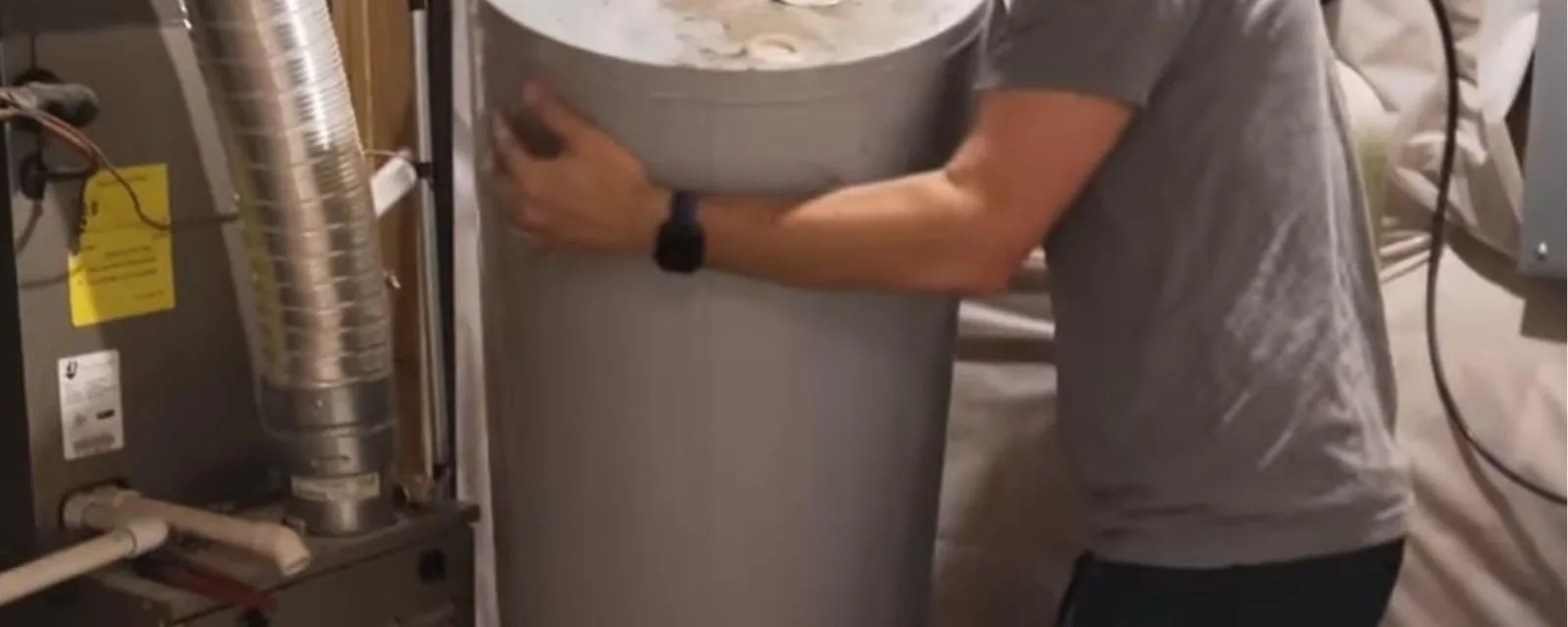
Water heater replacement cost in Hanahan, SC depends mostly on five things: the heater type, the fuel, the size, the venting or wiring, and the extra parts the manual and code call for. A plain tank for tank swap sits at the low end. A move to a gas tankless unit sits near the top.
We do not post prices on a web page, because the real number depends on your closet, attic or garage. What you should get is a clear price before work starts, with the parts and the labor named. The rest of this guide shows what belongs in that price and how to spot a quote that leaves things out.
Why two quotes for the same tank can differ
A water heater is a short list of parts and a longer list of tasks on site. The labor is draining and removing the old unit, setting the new one level, reconnecting water and fuel, testing for leaks and combustion, and hauling the old tank away.
Quotes split apart on the extras. One contractor reuses an old vent connector and flex lines, and another replaces them because the new unit's manual calls for it. One includes a drain pan and an expansion tank, and another lists them as options. When two numbers are far apart, the cause is usually a line item one quote left out, not a better tank.
Access changes the job too. A first floor closet is a different afternoon from a tight attic. Homeowners in Goose Creek and North Charleston can call us, and the first thing we need is where the heater sits.
Some line items on a replacement quote exist because the code requires them. The City of Hanahan lists the 2021 International Plumbing Code (IPC) and the 2020 National Electrical Code (NEC), each with South Carolina modifications, covering parts such as the relief valve discharge and electrical connections.
Ask the installer which line items come from code and which are choices, and ask Building and Codes whether a permit applies.
Sources: City of Hanahan, Building Codes and SC LLR, Building Codes in Effect for South Carolina. Checked October 2026.
What affects the price of replacing a water heater
These are the line items that move a replacement price up or down.
- Tank or tankless
- A tank is the lower starting point. A tankless unit costs more to buy and often needs a larger gas line, new venting or a heavier circuit. If you are weighing that jump, read about tankless water heater service first.
- Fuel
- Gas, electric and heat pump models use different parts and need different things from the room. Changing fuel is a bigger job than a like for like swap, because the gas line, vent or circuit has to change too. The Department of Energy says a heat pump water heater can be two to three times as energy efficient as a standard electric tank, so ask for running cost beside install price.
- Size and rating
- A bigger tank costs more and needs the floor space for it. The number that matters for hot water supply is the first hour rating, not only the gallons on the label.
- Venting or wiring
- A gas heater needs a vent that carries exhaust out of the house, and an electric one needs a circuit sized for its elements. If the old setup does not match the new unit's manual, that work gets added.
- Code items and access
- A relief valve with a proper drain line, a drain pan, an expansion tank and new shutoff valves are common additions. Ask the City of Hanahan Building and Codes department whether a permit applies to your swap.
Insurance often covers sudden damage from a tank that fails and floods a floor, but it usually does not pay for the worn out heater itself. Ask your carrier before you throw anything away, and photograph the data plate and any water damage.
Call (855) 575-2890, describe your heater, and we will give you a clear price before work starts.
Repair, replace or upgrade: a decision table
Match what you see to what it usually means, then use the last column as your question for the plumber.
| What you see | What it usually means | What to ask the plumber |
|---|---|---|
| Water pooling at the base of the tank | The tank shell has probably failed, and a repair cannot close a hole in it | Is the water coming from the tank or from a fitting above it? |
| Rusty or brown hot water, clear cold water | Often corrosion inside an aging tank or a spent anode rod | How old is the heater, and what does the anode rod look like? |
| Pilot or burner trouble on a younger gas unit | Often a thermocouple, flame sensor or gas valve problem | What does the repair cost against the years the unit has left? |
| Heater is well past the age on its data plate | Replacement usually uses the money better than a repair | What would you change, such as size or fuel? |
A repair costs less on day one. A failing tank can turn that repair into a flooded floor, so ask the plumber to say plainly which row your heater belongs in.
Ready to book?Call and we will find the earliest slot, often the same day when the schedule allows.
Call (855) 575-2890How to compare water heater quotes line by line
Lay the quotes side by side and look for these items in each one.
- The exact model, capacity and fuel type of the new heater
- The first hour rating, which you can also read on the EnergyGuide label
- New water connectors and shutoff valves, or a reason the old ones can stay
- A temperature and pressure relief valve with a drain line routed to a safe spot
- An expansion tank, or a statement of why your system does not need one
- Vent pipe, gas connector or electrical work, written out as its own line
- Haul away of the old tank, and the permit question answered
- What the manufacturer's warranty covers
If a quote lacks a line, ask about it. Do not assume it is included.
Sizing: why the first hour rating beats gallons
The U.S. Department of Energy tells homeowners to choose a model whose first hour rating at least matches their peak hour demand. Its worksheet example lands on 66 gallons for one busy hour.
The EnergyGuide label lists the first hour rating in its top left corner. Compare it to your own busiest hour.
Signs the old heater is near the end
Tanks typically last roughly 8 to 12 years, and the Department of Energy gives a wider range of 10 to 15 years for storage water heaters, so treat 10 years as the point to start planning.
Look at the date code on the data plate to find your heater's age. Water heating is about 18 percent of home energy use per the same agency. Rumbling or popping from the tank, rust at the drain valve, and moisture around the base are common signs the tank is failing.
When a leaking water heater becomes an emergency
A slow drip from a fitting can wait for a daytime visit. A tank that is flooding a floor, water near the electrical panel, or a gas smell cannot. For flooding, close the cold supply valve above the heater, turn off the breaker or the gas valve only if you can do it without standing in water, and then call (855) 575-2890 for emergency water heater repair.
If you smell gas, leave the building, call 911, and call Dominion Energy from outside. Do not turn lights or switches on or off on your way out.
Hanahan local note: soft CWS water and what it means for your tank
Charleston Water System describes its water as moderately soft, with an average hardness of 58.4 ppm, or 3.4 grains per gallon. Hanahan sits inside the CWS retail area, so most homes here get that supply. For a replacement decision, that means heavy scale is not the usual reason a tank dies in this area, so do not accept a scale related line item as a default.
Tank life here is more often decided by age, by the condition of the anode rod and the top fittings, and by how the heater was installed. Ask the plumber to check for corrosion at the connections, because a leak there is a smaller repair than a failed tank shell. The Department of Energy's 10 to 15 year range for storage heaters makes the date code on your data plate more useful than any water test.
Soft water does not change how many gallons your family uses at 7 a.m., so size by the first hour rating and not by water chemistry. If you are unsure which utility serves your street, the City of Hanahan Public Works page lists Charleston Water System at (843) 727-6800 for water, so confirm there before you rely on the 3.4 figure.
- Sources checked (utility FAQ (Charleston Water System), federal energy agency guidance (U.S. Department of Energy), city government page (City of Hanahan Public Works))
- Charleston Water System FAQ (hardness, 3.4 grains per gallon)
- U.S. Department of Energy, Sizing a New Water Heater
- U.S. Department of Energy, Water Heating
- U.S. Department of Energy, Tankless or Demand-Type Water Heaters
- U.S. Department of Energy, Heat Pump Water Heaters
- City of Hanahan, Public Works, Important Phone Numbers
Frequently asked questions
How long does a water heater last before I have to replace it?
Tanks typically last roughly 8 to 12 years, and the Department of Energy gives a wider 10 to 15 year range. Treat 10 years as the point to start planning, and check the date code on the data plate to see where yours stands. Leaks at the tank base, rusty hot water and rumbling are signs to start pricing a replacement.
Can you give me a replacement price over the phone?
We will ask the fuel type, the size, where the heater sits and what the data plate says. With those details we give you a clear price before work starts, and anything that changes on site is explained before it is added.
Is it cheaper to repair a water heater or replace it?
On the day, replacement costs more than a repair. The better question is how much life the tank has left. A leaking tank shell cannot be repaired, while a bad element or thermostat often can.
Does a water heater replacement in Hanahan need a permit?
Ask the City of Hanahan Building and Codes department. We do not state permit rules from memory, because they can differ by job type and fuel. Ask your plumber to say who pulls the permit if one applies.
Does Hanahan's soft water mean my new water heater will last longer?
It means scale is not the main threat. CWS reports 3.4 grains per gallon, which it calls moderately soft. Age, anode rod condition, pressure and installation quality still decide how long a tank lasts, so do not expect soft water alone to add years.